Erie County Clerk of Court serves as the official records office for court filings and legal documents in Erie County. The office supports court administration within the New York State Unified Court System and maintains accurate case records for public reference. It processes civil and criminal filings, records judgments, and certifies legal documents. Residents, attorneys, and businesses rely on this office for public filing services, including property records, liens, and business certificates. The Clerk protects permanent court archives and maintains organized docket entries. Through structured recordkeeping systems, the office keeps legal documentation secure, searchable, and properly indexed for countywide use.
The Erie County Clerk’s Office operates under an elected County Clerk who oversees both administrative and court-related duties. Judges issue rulings, yet the Clerk manages filings, fee collection, and document certification. The office handles Supreme Court civil cases, divorce proceedings, commercial disputes, foreclosures, criminal indictments, and name change petitions. Staff members maintain electronic and paper records to support efficient case tracking. This dual role separates judicial decision-making from record management responsibilities. By preserving official court documents and maintaining transparent public records, the office strengthens accountability and supports the smooth operation of county courts.
What are the Services Provided by the Erie County Clerk?
The Erie county clerk office NY provides court filing assistance, maintains official records, and delivers public counter services for legal and business needs in Erie County. The office processes civil and Supreme Court cases, issues business certificates, handles DBA filings, and offers notary, passport, and record certification services. Through these structured services, the Erie county clerk office NY supports court administration, public record integrity, and essential filing needs across Erie County Court.
Civil Case Filings
The Erie County Clerk’s Office manages civil case filings for the Supreme Court level. Plaintiffs, attorneys, and self-represented litigants submit summons, complaints, motions, and other legal documents through the county clerk office services counter or approved electronic systems. Staff review documents for filing requirements, collect statutory fees, and assign index numbers. These steps create an official court record and begin the case process. The office then maintains docket entries and preserves filings for long-term storage.
Civil matters may include:
- Personal injury claims
- Contract disputes
- Property litigation
- Divorce actions
- Foreclosure proceedings
Supreme Court Case Processing
The Erie county clerk office NY supports Supreme Court case processing under the supervision of the New York State Unified Court System. Judges handle rulings and trials. The Clerk manages administrative tasks that keep cases organized. Accurate case processing supports transparency and public record integrity. Attorneys often request certified copies for appeals, title transfers, or enforcement actions.
These responsibilities include:
- Entering judgments
- Recording verdicts
- Maintaining case dockets
- Certifying court orders
- Archiving final case files
Business Certificates & DBA Filings
Entrepreneurs rely on the county clerk office services to register business names. The office issues Business Certificates for sole proprietorships and partnerships operating under an assumed name. DBA filings (“Doing Business As”) create a public record that links a business name to its owner. This protects consumers and financial institutions by identifying responsible parties.
Common steps include:
- Completing a Business Certificate form
- Filing the document at the public counter
- Paying the required filing fee
- Receiving a stamped, certified copy
Notary Public Services
The Erie county clerk office NY files Notary Public oaths and maintains a public record of commissioned notaries within the county. Newly appointed notaries must take and file their oath before performing official acts. Residents may verify a notary’s commission status through official records.
The office records:
- Notary commissions
- Oath of office documents
- Signature samples
Passport Processing
Many residents visit the public counter services area for passport applications. The Clerk’s Office acts as a passport acceptance facility authorized by the U.S. Department of State. Processing times depend on federal review timelines.
Services typically include:
- Reviewing application forms
- Verifying identity documents
- Administering required oaths
- Forwarding completed applications
How to Search Erie County Clerk Records
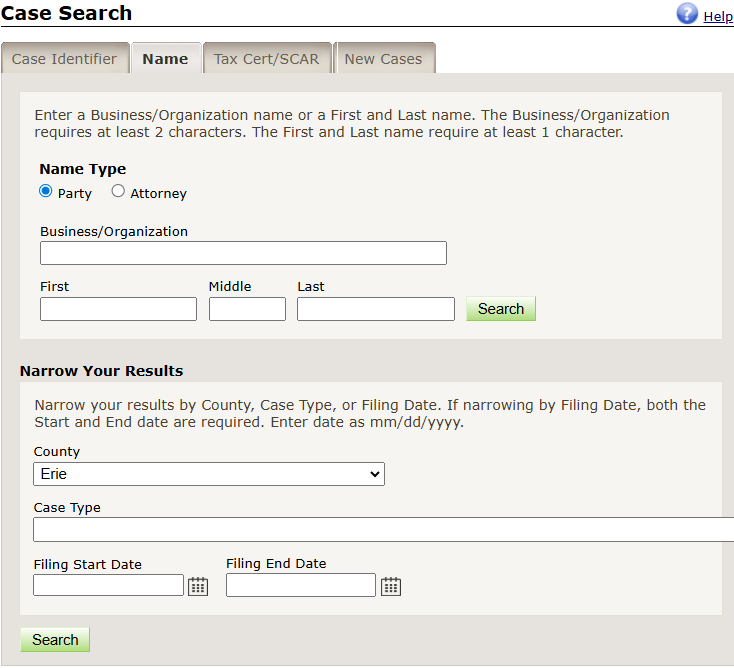
Erie county clerk records for Supreme Court civil cases can be searched online through the official NYSCEF Name Search system managed by the New York State Unified Court System. After locating a case index number, users can request certified or non-certified copies from the Erie County Clerk’s Office in Erie County. Follow these clear steps to locate civil court records and obtain a case index number.
Open the NYSCEF Name Search Page
- No account is required for basic name searches.
- Visit the Official link: https://iapps.courts.state.ny.us/nyscef/CaseSearch?TAB=name.
Choose Search Type
Most users select Party Name. Select one option:
- Party Name
- Attorney Name
Enter Name Details
For individuals:
- First name
- Middle name (optional)
- Last name
For businesses:
- Enter at least two characters of the company name.
Filter by County
Locate the County dropdown menu and select: Erie
Optional filters:
- Case Type (Civil, Matrimonial, Foreclosure)
- Filing Date Range (MM/DD/YYYY format)
Review Search Results
The system displays:
- Case Index Number
- Filing Date
- Case Type
- Party Names
Requesting Copies from the Erie County Clerk
After locating the case index number, copies can be requested through the Clerk’s Office.
Provide the following details:
- Case Index Number
- Full Party Name
- Filing Year
- Specific document requested
- Certified or non-certified copy preference
Current Erie County Clerk of Court
The Erie county clerk of court in Erie County is an elected county official responsible for maintaining official court and land records. As the chief records custodian and court administrator, the Clerk oversees filings, document preservation, and public service operations.
Who Is the Current Erie County Clerk?
The current Erie county clerk of court is Michael P. Kearns. He serves as the elected County Clerk for Erie County and holds a four-year term under New York State law. The position is filled through a countywide election, which places the office directly accountable to voters. As an elected county clerk, Michael P. Kearns operates within county government and works alongside other elected officials. The Clerk’s Office functions independently from judges, yet supports the court system through administrative services. Public accountability remains central to the role, since residents rely on accurate records for legal, property, and business matters.
Core Responsibilities of the Erie County Clerk
The Erie County Clerk holds several important administrative and legal duties that support both the court system and the public. This office ensures that official filings are properly recorded, organized, and made accessible according to state laws. By managing court documentation, property records, and public filings, the Clerk helps maintain transparency and accountability. These core responsibilities form the foundation of accurate recordkeeping and efficient county operations.
Custodian of Official Records
Maintaining these records protects property rights and preserves legal history. The office safeguards both paper archives and digital systems. The Erie county clerk of court acts as the official records custodian for a wide range of documents. These include:
- Land and property records
- Deeds and mortgages
- Civil court filings
- Judgment records
- Business certificates and DBA filings
Supreme & County Court Clerk Functions
Judges make legal decisions. The Clerk manages documentation and record accuracy. This separation supports transparency and organized case processing. As Clerk of the Supreme and County Courts, the office performs key court administrator duties:
- Assigning case index numbers
- Managing case indexing systems
- Entering judgments and court orders
- Recording verdicts
- Preserving permanent civil case files
Public Service Leadership & Modernization
The Erie county clerk of court promotes record transparency and improved public service. Recent efforts across New York counties focus on digital modernization, expanded electronic filing systems, and improved online search tools. Electronic case management under the New York State Unified Court System has strengthened document tracking and reduced manual processing time. E-filing expansion supports faster submissions and better public access to case information.
Erie County Filing Fees
Erie county filing fees apply to civil case initiation, motion practice, court administration steps, and document reproduction handled by the Erie County Clerk’s Office in Erie County. These court filing charges follow New York State statutory schedules and apply primarily to Supreme and County Court matters. Filers must pay required document filing costs at the time of submission to avoid rejection or delay. The table below presents commonly assessed fees in one clear schedule for easier reference.
Complete Erie County Filing Fee Schedule
| Filing / Service Type | Description | Fee (USD) |
|---|---|---|
| Index Number (Supreme Court Civil Case) | Required to begin a civil action | $210.00 |
| Request for Judicial Intervention (RJI) | Assigns case to a judge | $95.00 |
| Note of Issue (if applicable) | Places case on trial calendar | $125.00 |
| Motion Fee (where applicable) | Court application fee if required by statute | Varies by case status |
| Transcript of Judgment Filing | Filing of judgment from another court | $10.00 |
| Satisfaction of Judgment Filing | Recording satisfaction document | $5.00 |
| Photocopies (per page) | Non-certified document copies | $0.65 per page |
| Certified Copy (per document certification) | Clerk seal verification | $8.00 |
| Exemplified Copy | Triple-seal authentication | $25.00 |
| Business Certificate Filing (DBA – Individual) | Assumed name filing | $25.00 |
| Business Certificate Filing (Partnership) | Assumed name filing | $25.00 |
| Notary Oath Filing | Filing of Notary Public oath & signature | $10.00 |
Key Filing Cost
- The Index Number fee officially opens a civil lawsuit.
- The RJI fee moves a case into active judicial supervision.
- Copy and certification fees apply per document requested.
- Business certificate and notary filings fall under county clerk administrative services.
Document Filing Process in Erie County
Document filing in Erie County follows structured procedures established by the New York State Courts Electronic Filing System and local Clerk protocols. Most Supreme Court civil cases use electronic submission, which allows attorneys and approved users to file documents online, track case activity, and receive confirmations in real time. The filing process begins when a party prepares required legal documents. These may include a summons, complaint, petition, motion papers, or supporting affidavits. Filers must confirm formatting rules, signature requirements, and payment of statutory filing fees before submission. Document Filing Process is given below
- Create or Access NYSCEF Account: Attorneys and authorized users log into the New York State Courts Electronic Filing System. Self-represented litigants may register for consent-based electronic filing in eligible cases.
- Start a New Case or File into Existing Case: For new cases:
- Purchase an Index Number
- Upload initiating documents
- Pay required filing fee
- For existing cases:
- Enter case index number
- Select document type
- Upload motion or supporting papers
- Pay Required Filing Fees: Electronic payments are processed during submission. Filing does not become official until payment clears.
Clerk Review & Court Document Processing
After submission, the Clerk’s Office reviews the filing for compliance. Staff verify:
- Correct case number
- Required fees paid
- Proper document type selection
- Completeness of submission
Confirmation & Case Tracking
Electronic submission improves speed and transparency in court document processing. Once accepted, filers can:
- View docket updates
- Download filed documents
- Track motion submissions
- Monitor court activity
Court Administration & Case Processing
Court administration in Erie County ensures that civil and county court matters move through a structured workflow. Administrative functions operate in coordination with the New York State Unified Court System while record management duties remain under the Clerk. Efficient administration supports accurate docket management and long-term judicial records maintenance.
Case Indexing
Every civil action begins with assignment of an Index Number. This number identifies the case across all filings and proceedings. Accurate indexing prevents duplicate records and supports organized case tracking.
Clerk staff:
- Assign index numbers
- Enter party information
- Categorize case type
- Create official docket entries
Scheduling & Case Flow
After a Request for Judicial Intervention is filed, the case enters judicial supervision. Clerk personnel update docket entries to reflect court dates, adjournments, and decisions. Judges control rulings and scheduling orders. The Clerk maintains administrative records of those actions. Scheduling may include:
- Preliminary conferences
- Motion return dates
- Trial calendar placement
Judicial Records Maintenance & Retention
The Clerk preserves court files in both electronic and archived formats. Record retention follows New York archival standards. Older paper files may be stored off-site and retrieved upon request. Through structured docket management, case indexing, and document preservation, court administration in Erie County maintains accurate legal records and supports orderly case progression. Judicial records maintenance includes:
- Permanent retention of Supreme Court civil case files
- Secure storage of judgments and orders
- Digital backup of electronic submissions
Online Services & Digital Access
Erie county clerk office NY offers secure digital tools that allow users to complete filings, search cases, and retrieve documents without visiting the courthouse. Through statewide court technology systems and local online portals, residents can perform online case lookup, submit electronic filings, and review digital court records from any location.
E-Filing Portal
Supreme Court civil cases use the New York State Courts Electronic Filing System. The e-filing portal reduces paperwork and speeds up court document processing. This platform allows attorneys and approved self-represented litigants to:
- Start new civil actions
- Upload motions and supporting documents
- Pay filing fees electronically
- Receive confirmation receipts
- Track docket activity
Online Case Lookup
Users can search digital court records through:
- NYSCEF Name Search
- Index number lookup tools
- Case status tracking portals
Online case lookup displays:
- Case index number
- Filing date
- Case type
- Party names
- Document list (when available)
Online Payments & Record Downloads
Digital court records may be downloaded directly when available. Some documents require formal copy requests or certification through the Clerk’s Office. Online services streamline filing, payment, and case tracking for Erie County court users. Electronic payments allow filers to pay:
- Index number fees
- Request for Judicial Intervention fees
- Motion-related charges
Record Certification & Official Copies
Record certification confirms that a court or property document is a true and accurate copy of the original on file with the Erie County Clerk’s Office. Certified court documents carry the Clerk’s official seal and signature, making them legally valid for court proceedings, real estate transactions, and government submissions.
Certification Process
To obtain certified court documents:
- Provide the case index number or document reference.
- Identify the exact document requested (judgment, order, deed, etc.).
- Request a certified copy instead of a regular copy.
- Pay the required certification fee.
Identification Requirements
Requesters may need to present:
- Government-issued photo ID
- Written authorization (if requesting on behalf of another party)
- Case information for verification
Processing Times
Standard copy requests are often completed within several business days. Archived records may require additional retrieval time. Certified copies differ from notarized copies. A certified copy confirms authenticity from the Clerk. A notarized copy verifies the identity of a signer. Processing times vary based on:
- Volume of requests
- Archive retrieval needs
- In-person or mail submission
Property & Land Records Division
Erie county clerk records include a dedicated Property & Land Records Division responsible for deed recording, mortgage filing, and lien records management in Erie County. This division preserves ownership history and protects property rights through accurate public documentation.
Deed Recording
When a property changes ownership, the deed must be officially recorded with the Clerk’s office. This recording process creates public notice of the transfer, establishes legal priority, and updates the land records database to reflect the new ownership details. To complete the filing, the required documents typically include an executed deed, applicable transfer tax forms, and payment of the recording fees. Once the submission is reviewed and accepted, the Clerk assigns a recording number and permanently archives the deed for future reference.
Mortgage Filing
Mortgage documents secure loans against property. Filing a mortgage:
- Establishes lender interest
- Records repayment terms
- Protects lien priority
Lien & Judgment Records
Recording these documents places the public on notice of outstanding claims. The Clerk maintains searchable land records for transparency. Property records remain permanent public records. Older files may exist in archived or digitized format. Lien records reflect legal claims against property, including:
- Judgment liens
- Tax liens
- Mechanic’s liens
Business, DBA & Notary Services
The Erie County Clerk provides business and notary services that support local entrepreneurs and public officials. These services include assumed name filing, partnership certificate registration, and notary public registration, which may be referenced in filings connected to municipal court or surrogate court matters.
Assumed Name & Partnership Certificate Filing
Sole proprietors and partnerships operating under a trade name are required to file a Business Certificate with the Clerk’s Office. This assumed name filing connects the business name to its legal owner, creates a public record for transparency, and allows banks and other institutions to verify ownership when opening accounts or conducting transactions. To complete the process, applicants must fill out the Business Certificate form, submit it to the Clerk’s Office, pay the required statutory fee, and obtain a certified copy for their records. Partnership certificates generally follow similar filing procedures and requirements.
Notary Public Registration
Newly commissioned notaries are required to file their Oath of Office along with a signature sample with the Clerk’s Office. Once submitted, the Clerk records the notary’s registration and maintains official records of active notaries within Erie County. This process ensures that notarizations can be verified and that notaries operate in compliance with state regulations. These administrative services play an important role in supporting legal compliance, promoting business transparency, and maintaining public trust throughout Erie County.
Locations & Public Counter Services
County clerk office services in Erie County are provided through the main public counter operated by the Erie County Clerk’s Office in Buffalo. The office handles court filings, land records, business certificates, certified copies, and in-person assistance for legal document processing. The Buffalo NY clerk office serves as the primary location for Supreme Court civil filings and property recording. Visitors can obtain certified court documents, file deeds, submit business certificates, and request case searches at the public counter.
Main Office Address
This downtown Buffalo location houses court administration staff and land records operations. It serves residents, attorneys, title companies, and business owners across the county.
Erie County Clerk’s Office
92 Franklin Street
Buffalo, NY 14202
Office Hours
Hours may vary on holidays or during severe weather conditions. Visitors are encouraged to confirm office hours before arrival. Standard public counter hours are typically:
- Monday through Friday
- 9:00 AM – 5:00 PM
Parking Information
The Buffalo NY clerk office is located in a central government district. Parking availability can vary during peak hours. Arriving early may reduce delays. Visitors may use:
- Nearby public parking garages
- Metered street parking
- Designated municipal parking facilities
Security Procedures
As the office operates within a government facility, security screening may be required upon entry. Prohibited items are not allowed inside the building. These measures protect staff and visitors. Visitors should expect:
- Bag inspections
- Metal detector screening
- Photo identification requests for certain services
Accessibility & Public Services
The county clerk office location in Buffalo provides accessibility accommodations for individuals with disabilities. The building includes elevator access and ADA-compliant entrances. Service counters are structured to assist individuals requiring additional support. Staff members assist visitors with procedural questions related to document filing and record searches.
Public counter services commonly include:
- Civil court filing assistance
- Certified copy requests
- Property and deed recording
- Business certificate filings
- Notary oath registration
Frequently Asked Questions
The following frequently asked questions provide clear, direct answers about the erie county clerk of court, its responsibilities, filing procedures, and public services in Erie County. This section is structured to address high-intent search queries and help residents, attorneys, and property owners quickly understand how the Clerk’s Office operates. The information covers court filings, land records, fees, online access, and office location details. Each answer offers practical guidance for navigating services provided through the official County Clerk system.
Who is the Erie County Clerk?
The Erie County Clerk is Michael P. Kearns, the elected official responsible for managing civil court records and land recordings. The Clerk serves a four-year term and oversees recordkeeping for Supreme Court civil matters, property deeds, business certificates, and judgments. While judges make legal decisions, the Clerk ensures that filings are processed correctly, fees are collected, and records are preserved. The office also provides certified copies of official documents and maintains archival case files. As a countywide elected position, the Clerk represents the public in maintaining transparent, accessible court and property records.
What does the Erie County Clerk do?
The Erie County Clerk’s Office manages and preserves official records for civil court cases and land transactions. The office assigns index numbers for lawsuits, records property deeds and mortgages, files judgments, and processes business certificates. It also certifies copies of court documents for legal use. The Clerk does not issue court rulings but ensures that all documents submitted comply with New York filing standards. In addition, the office maintains digital and archival systems to protect permanent public records. Through in-person and online services, the Clerk supports attorneys, homeowners, and businesses seeking accurate legal documentation.
How do I search Erie County Clerk records?
You can search civil case records online through the New York State Courts Electronic Filing System by entering a party name, attorney name, or index number. Property records, including deeds and mortgages, are searchable through the Clerk’s land records system. Most searches require basic identifying details such as property address, owner name, or filing year. Public terminals may also be available at the Buffalo office for in-person research. Online systems allow users to view case summaries and document listings, while full copies may require a fee. Searching electronically is typically the fastest way to locate court or property information.
What are Erie County filing fees?
Filing fees are set by New York State law and vary depending on the type of document. A Supreme Court civil Index Number typically costs $210, while a Request for Judicial Intervention is $95. Recording fees for deeds and mortgages depend on document length and property details. Copies are generally charged per page, and certification requires an additional fee per document. Payment can often be made online through the e-filing system or in person at the Clerk’s counter. Because fees may change, it is advisable to verify current rates before submitting documents to avoid processing delays.
Where is the Erie County Clerk office located?
The main County Clerk office is located at 92 Franklin Street in downtown Buffalo. This central location houses civil court filing counters, land records services, and document certification assistance. The office operates during regular weekday business hours, excluding holidays. Visitors should allow extra time for security screening when entering the building. Public parking garages and street parking are available nearby. Accessibility features are provided to accommodate individuals with disabilities. Checking office hours before visiting is recommended, particularly during holiday weeks or severe weather conditions that may affect operations.
How do I file documents in Erie County?
Most Supreme Court civil filings are submitted electronically through the New York State e-filing platform. After creating an account, users upload required documents, pay applicable fees, and receive electronic confirmation. Some documents that are not eligible for e-filing may be filed in person at the Clerk’s Office. When filing, ensure that documents are properly formatted, signed, and include any required supporting forms. Payment methods vary depending on filing type and submission method. Once accepted, the filing becomes part of the official court record and can be accessed through the appropriate search system for future reference.